Singing Pancakes
And In Praise of the Hand-Held Blender

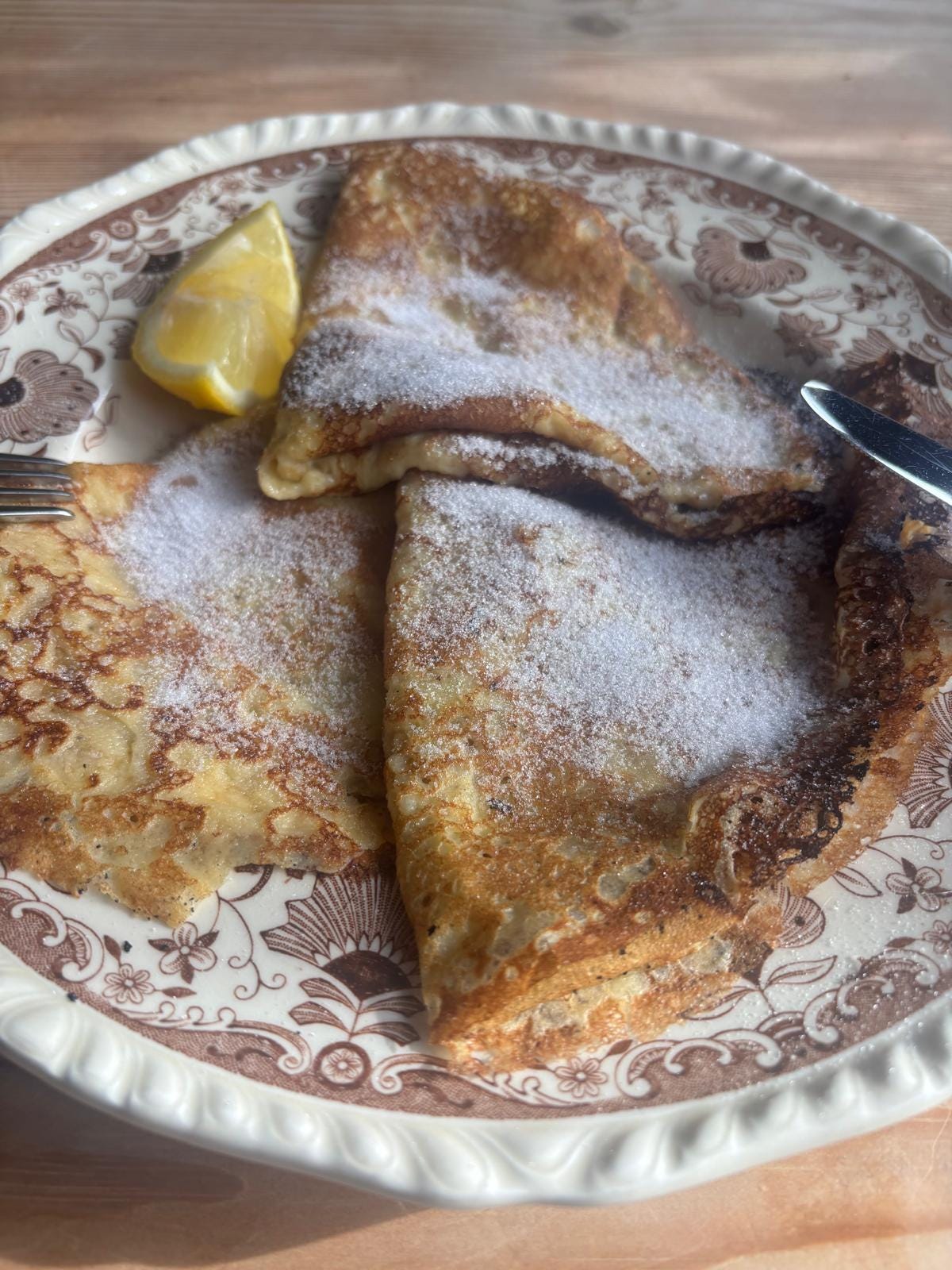
One of the most startling pancake recipes I ever read comes in a fourteenth-century advice book called Le Ménagier de Paris (published in 1393). I wrote about this fourteenth-century recipe in my book CONSIDER THE FORK (which, in case you are interested, is out in a new audio book which I recorded late last year).
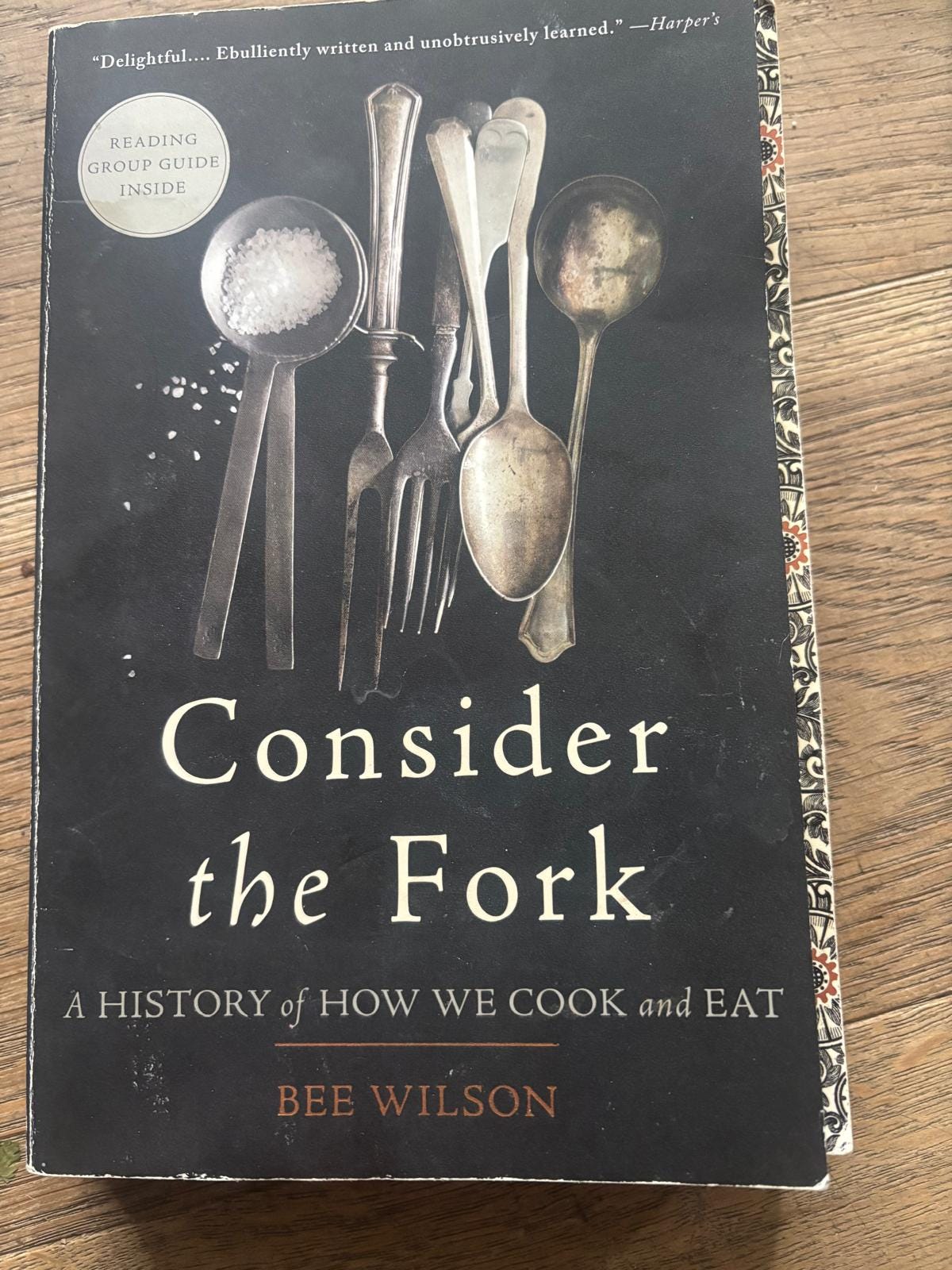
The recipe goes like this:
First, get a quart-sized copper pan and melt a large quantity of salted butter. Then take some eggs, some “warm white wine” (this take the place of our milk) and “the fairest wheaten flour” and beat it all together “long enough to weary one person or two”. Only then is the batter done.
It gives you a jolt to read this phrase “one person or two” in this old recipe. It conjures up a rich kitchen in which there is a team of human egg beaters ready to weary themselves for the sake of their mistress’s pancakes. The recipe goes on to say that all the time that the pancakes are being fried, a second person must carry on ‘moving and beating the paste unceasingly’.
In our electric age when the ‘fairest wheaten flour’ can be bought for a pound or so in any supermarket, it’s hard to remember that pancakes – along with other airy egg-based things – were once among the most labour-intensive dishes to cook, at least in the versions that were eaten by rich people. The pancakes in question would have been more about thin French-style crêpes rather than puffy American-style pancakes which famously must not be over-mixed if you want to keep them light (and which only reached their current form in the nineteenth century with the advent of baking powder).
When I read historic recipes such as this one, which involve so much grind, my main emotion is gratitude for my hand-held blender, this inexpensive marvel. In my house, I am glad to say that no one has to weary themselves for the sake of pancakes (if we do not count the dairy cows and the hens who laid the eggs). My son or I just get out the stick blender and a measuring jug, blitz up some flour, eggs, milk, melted butter and salt and we are ready to make crêpes, something we do for breakfast so often – at least once a week - that ‘Pancake Day’ no longer feels quite as ceremonial as it once did.
Some say that some of the poetry of cooking got lost along with the advent of electrical gadgets. There is some truth in this. Every kitchen technology involves trade-offs and the sheer speed of the hand-held blender means that you do not become intimate with the pancake batter and its moods in quite the same way that cooks did in the past.
A few years ago, I was amazed to learn that crêpe batter used to be measured not just by its texture but by its sound. When I was writing THE SECRET OF COOKING, someone called James Rae Smith told me on Twitter that his mum learned to make pancake batter by whisking with a big kitchen spoon in a circular motion ‘until the batter sings’. When there is enough air in the batter, he said that it starts to make a faint bell-like ringing. It sounded unlikely. But then I tried it and lo and behold, it is true: yet another sign that traditional cooks know far more than they are given credit for.
Making singing pancakes is worth trying at least once in your life because to extract music (albeit some very quiet and undramatic music) from a bowl of batter feels like a tiny piece of sorcery on a dull day. Whisk together the milk, eggs, flour, salt and melted butter (see quantities below) in a big mixing bowl using a balloon whisk until all the lumps are gone. Then switch to a big wooden spoon and keep mixing in circular motions until the batter ‘sings’. At first all you will hear is the splashing of the spoon and you may feel tempted to give up. Feel free to switch to the blender at this point. I have to warn you that last time I tried this, it took twenty minutes of continuous stirring and I couldn’t even distract myself with a podcast because I was listening so intently. By the time the singing finally happened in the bowl, my arms were aching and my patience was wearing thin.
And then, just when you think the very idea is absurd, the sound comes. It isn’t anything huge. At first, you may think it’s the noise of a far-away aeroplane outside until your senses assure you that yes, it really is the batter itself which is making this strange bell-like drone in response to the stirring motion of your spoon. It is a quiet but insistent noise somewhere between ringing and humming: a bit like a calming Buddhist bell heard from afar. I cannot explain the Physics of where the singing comes from – and would be grateful to anyone who can help – except to say that it is clearly something to do with the particular acoustics of bubble formation in batter.
What do these singing pancakes taste like when the batter is finally ready? I wish I could tell you that they are no different to the electric blended kind. But annoyingly, the few times I’ve made singing batter, the pancakes that result are gloriously lacey and delicate. I thought the crêpes might be gummy from all that stirring but the opposite was true. They were tender yet cohesive. On Serious Eats, J. Kenji Lopez-Alt notes that using a bowl and balloon whisk for crêpes produces less aeration than a blender ‘which in turn leads to slightly denser, smoother crêpes’ and these spoon-stirred singing crêpes seem to be even smoother than the balloon-whisked kind.
Whether it’s worth all that bother is an entirely different matter. The main thing I thought after stirring up these singing crêpes with my wooden spoon was that I would happily exchange the poetry and marginally smoother pancake of a hand-stirred batter for the speed and ease of my trusty hand-held blender. The pancakes are bubblier than the hand-stirred ones but actually, I like those little bubbles. Yes, the blender makes an ugly buzzing sound. But given that the batter is ready in a mere 15 seconds and the pancakes never taste anything but lovely, that buzz is music to my ears. To me, all crêpes are singing ones.
However you make your pancakes, wishing you a Happy Pancake Day/Shrove Tuesday/ Mardi Gras xx
Singing Crêpes
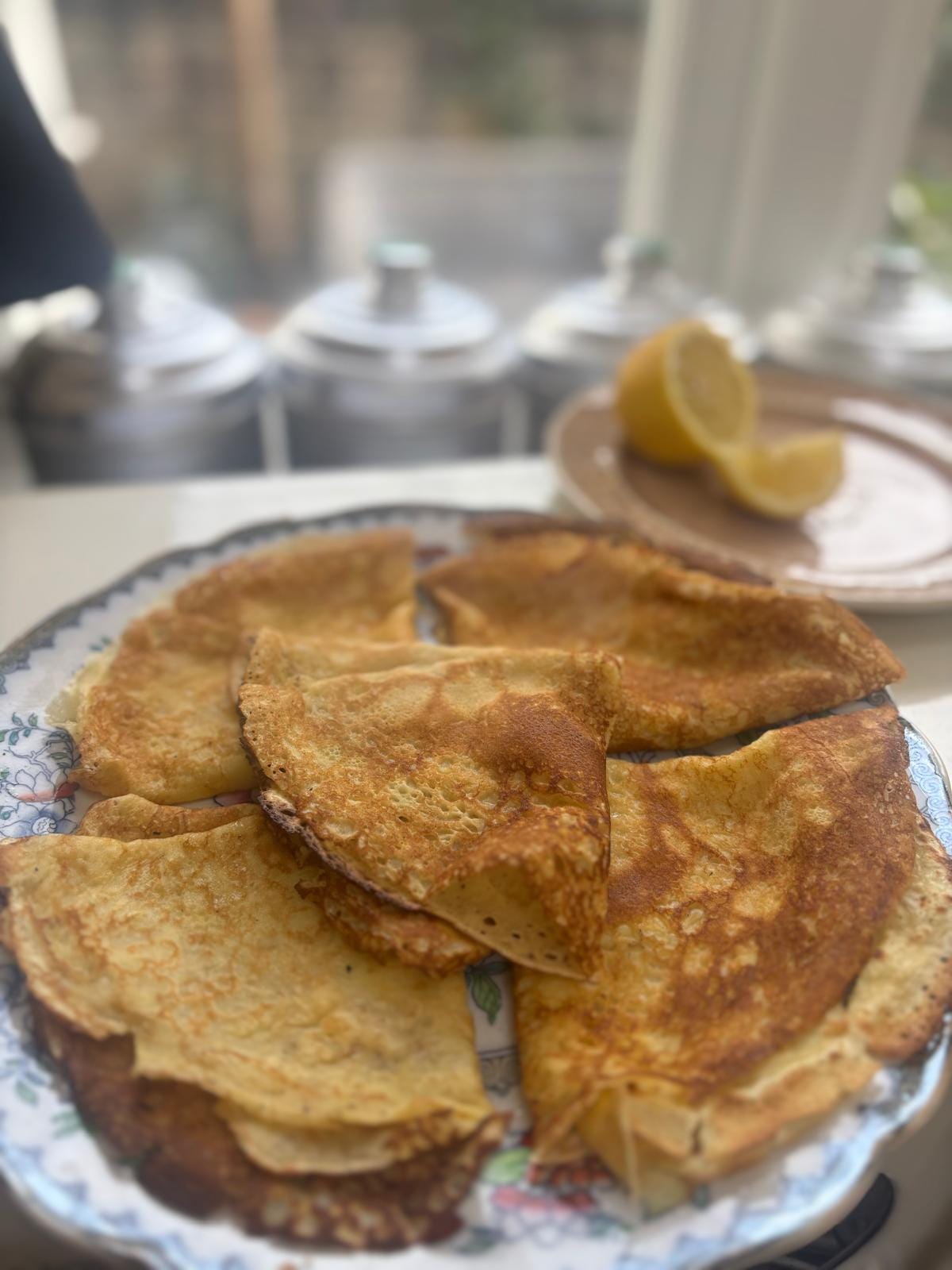
I very often double this recipe because the batter will keep in the fridge for 24 hours easily and 48 hours at a push.
300ml milk (any kind you like)
2 large eggs
120g plain flour
A pinch of salt
25g unsalted butter, melted
Vegetable oil to season the pan
More butter for cooking
The really key ingredient for pancakes is a trusty seasoned pan. I have a battered old aluminium pan that I reserve only for omelettes and pancakes. I try to ‘season’ it each time by heating it with a little bit of oil and then wiping it out before I cook the omelette or pancakes. But this will also work in cast iron (I am fond of my Netherton spun iron crêpe pan). For all kinds of reasons, I don’t like using non-stick. The main thing is for you to get to know your own pan. You will also need a ladle or large spoon for adding the batter to the pan and a palette knife or fish slice for turning the crêpes.
Put everything in a big measuring jug and blitz noisily with a hand-held blender. Check for any floury patches and blitz again. It will take about 15-30 seconds in all. Or if you have no blender, you can mix it all together with a balloon whisk in a mixing bowl. This takes around 5 minutes to get it perfectly smooth.
Heat your pan with a dash of vegetable oil over medium-hot heat until it is hot. Wipe the pan out and add a tiny nugget of butter, about as big as the nail on your little finger. The butter should instantly and loudly sizzle. If not, the pan isn’t hot enough; wipe it out and start again.
After you add the nugget of butter, quickly pour half a ladle of batter in the pan and swirl until it coats the whole bottom of the pan. Dribble in a little more batter to fill any gaps. Almost immediately, you will see the surface of the pancake start to set. When it is all set except for a few dots of batter in the centre, try to turn it wityh a fish slice or palette knife. Feel the edge of the pancake using your palate knife. Over time, you will know exactly how a pancake feels when it is ready to flip, but the first few times you may need to turn the edge over and take a peek, looking to see if a golden-brown pattern has formed.
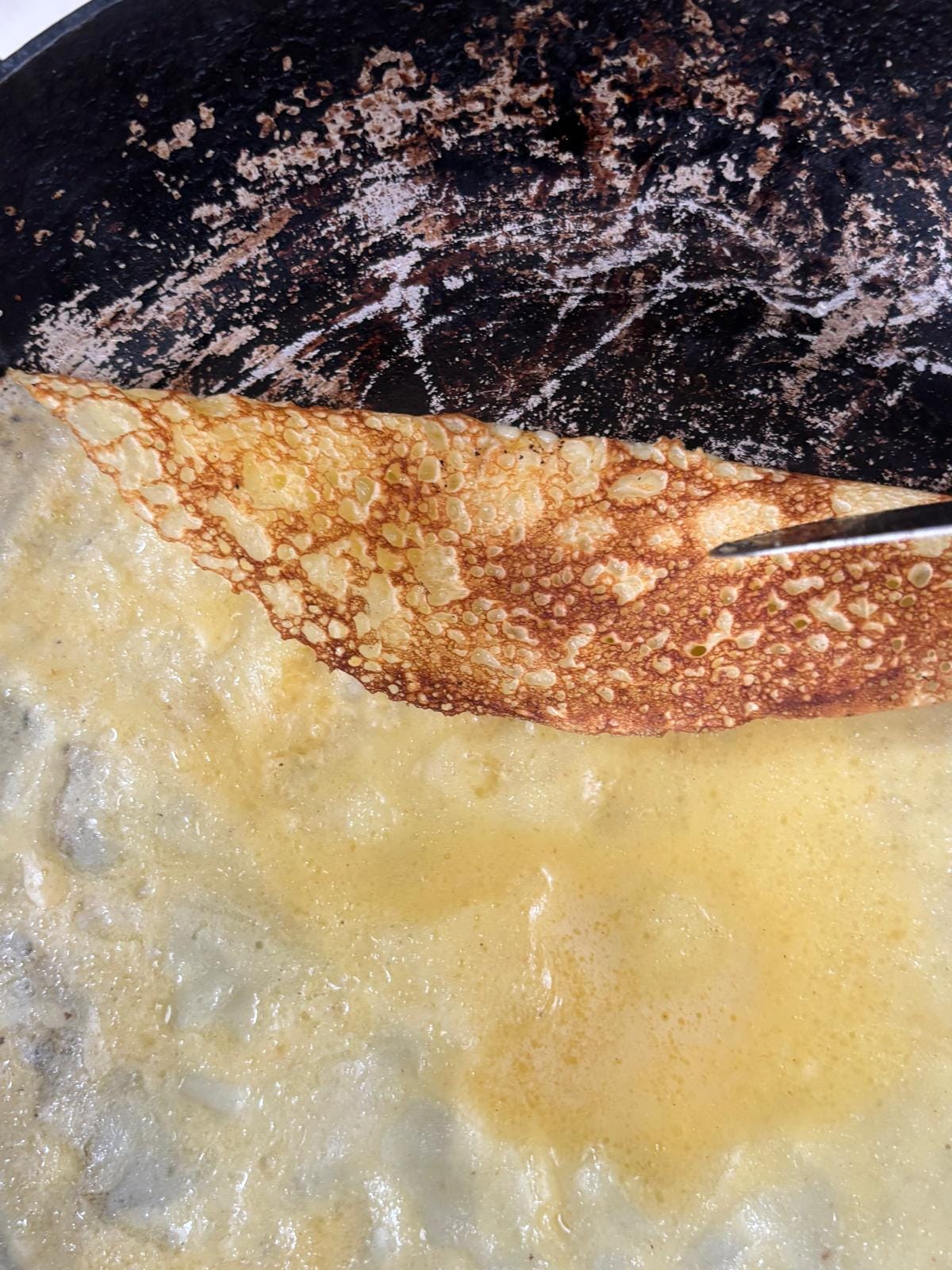
Once it is turned with a palette knife or fish slice, the pancake only needs a few seconds on the second side.
If you are keen to toss rather than turn, again it is listening that will help you the most. A pancake that is ready to toss will sound like feet shuffling when you shake it slightly.
This shuffling sound tells you that the pancake is totally dry underneath and won’t stick when you try to toss it (though accidents do still happen, which is part of the fun). Because I am now a boring middle aged person who cares more about eating tender pancakes than I do about the drama of tossing, I am now in camp ‘Turn’ which allows me to flip the crêpe a bit sooner and thus overcook it less than when I am tossing it.
Remove to a plate and repeat. Bear in mind that after a pancake or two, the pan will get too hot and you will need to turn the burner down.
Eat with sugar and lemon; or maple syrup and cinnamon; or any kind of jam; or turn into savoury pancakes with spinach and cheese; or on days when you need something spectacular, flambé them with Cointreau and oranges and turn them into Crêpes Suzette.
P.S. Some more unusual pancakes to try, both sweet and savoury:
Roopa Gulati’s Semolina Pancakes with Red pepper, Tomato and Red Onion from INDIAN KITCHENS: these are essentially savoury uttapam. As Roopa writes they are thicker than dosa. Her version is made from semolina which makes them quicker than the traditional version and they end up as a very moreish small crumpet-like pancake embedded with a mixture of onions, peppers and tomatoes. Delicious with coconut chutney.
Helen Goh’s Crepes with Red Bean Paste and Walnut Praline from BAKING AND THE MEANING OF LIFE – the most delicious pancakes-as-indulgent-dessert I’ve ever had. The walnut and black sesame praline is a wonder all by itself and then the pancakes are stuffed with a homemade red bean paste that tastes a bit like marron glacé.
Noor Murad’s pancakes with Cardamom and honey-lime syrup from LUGMA: so zingy and aromatic.
Ixta Belfrage’s green Pancakes with Yoghurt Sauce from FUSÃO. Like all of Ixta’s recipes, this is so clever. You make some emerald-green pancakes by blitzing spinach into the batter. And it then gets layered with a very quick fennel-scented meat ragu made in the oven and topped with a yoghurt sauce plus grated tomatoes for freshness. It’s inspired by Italian crespelle except that the colours are far brighter and the flavours are spicier.
This was a delight to read, Bee 💛💛💛 Crepes have been on my list for years to try, and I feel very inspired (and enchanted!?) by this post. Thanks for sharing.
What a lovely piece, and the whole idea of singing pancakes is fabulous! Grazie, Faustina