Re-Reading Fast Food Nation
Twenty-five Years On...

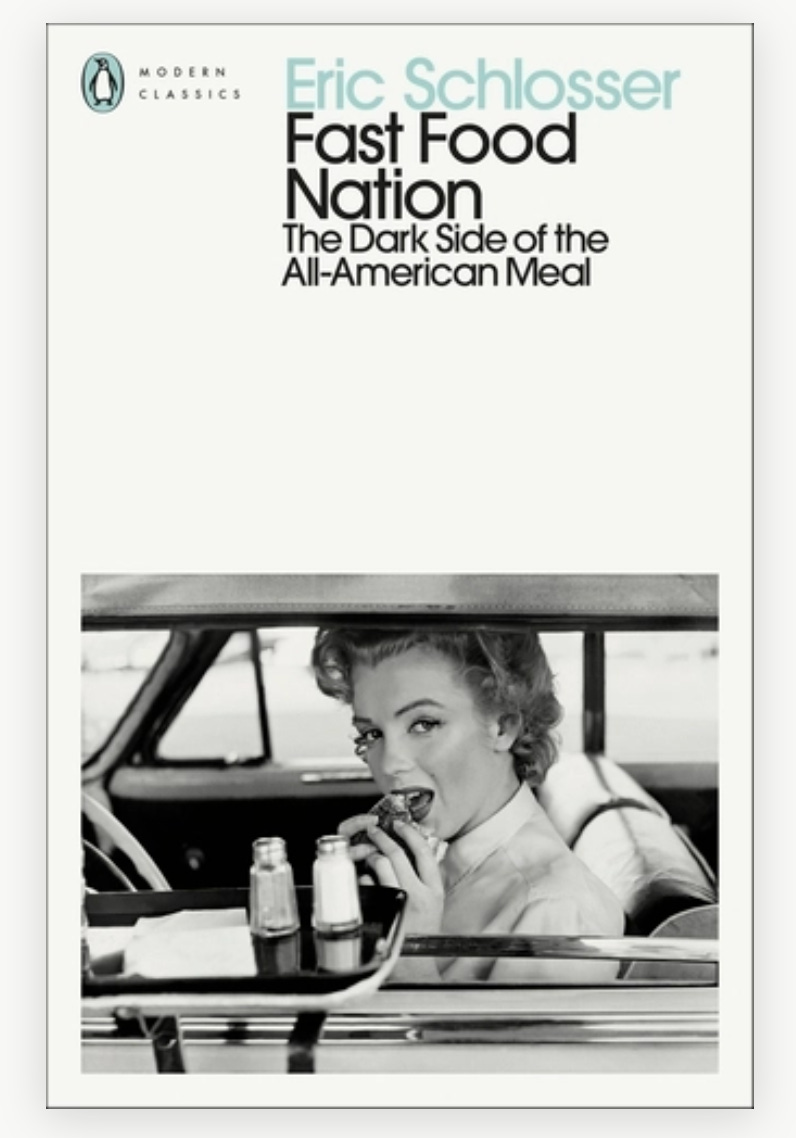
I thought I remembered FAST FOOD NATION by Eric Schlosser very well. It’s one of those rare non-fiction books many of whose details lodge themselves in your memory so indelibly that you feel forever changed by reading it. But when I returned it recently, it was a subtly different book from the one I remembered.
I should add that you should look away now if you don’t want to spoil your appetite. I’ll be doing a very nice post again soon - tomorrow, I hope - featuring Swedish cake. So do skip ahead to that one if you don’t feel up to reading about the horrors of fast food right now. I’m getting the feeling that a lot of us are feeling pretty shaky, one way and another. But do read FAST FOOD NATION one day, if you haven’t already. It’s a bona fide masterpiece of modern food politics.
Schlosser was a screenwriter before he turned to investigative journalism and it shows. He is a genius at storytelling with a spare prose style that forces you to pay attention and often chooses a slightly surprising or oblique narrative arc for his chapters. I’d forgotten how much of the book is not so much about fast food as about the people and places it has transformed, especially the area around Greeley, Colorado, one of the centres of American meatpacking where what was once one of the best-paid manufacturing jobs has become one of the worst paid with terrible injury rates and a constant stench. “You can smell Greeley, Colorado, long before you can see it’, he memorably writes.
A couple of weeks ago, I reviewed the new edition for The Sunday Times . I wrote, ‘It is now 25 years since Schlosser’s celebrated exposé of the secrets, the flavours, the horrors and the injustices of the modern fast food system and it has lost none of its immediacy and power’. After I finished the review, I found myself haunted by the book and wishing I could have said more about it.
When FAST FOOD NATION first came came out in 2001, I was in my late twenties and had grown up with milkshake dreams stoked by American movies and sitcoms. Even though I was already a food writer who cooked every day from scratch, I still nursed a bit of affection for the sheer Americana of McDonald’s, a legacy of my binge-eating teenage years when I believed that a red cardboard sheath of their fries was heaven and that a quarter pounder with cheese followed by a vanilla milkshake was the stuff of dreams. I was a student in the era of Tarantino The first McDonald’s opened in Britain the year I was born, 1974, and I will never forget the first time I visited a branch (maybe ten years later). It was for the birthday party of a school friend whose parents took a group of us all the way from Oxford to London and back just to eat at a branch of McDonald’s.
At that first McDonald’s meal, I chose a Filet-O-Fish and remember being slightly puzzled that this oversized fish finger sandwiched with sticky orange cheese in a distinctly sweet bun should be the cause of so much fuss. It was nothing like as tasty or as filling as the deeply British fish and chips wrapped in paper which my mother sometimes bought for our dinner when she was too tired to cook. And why did it taste so strongly of dill? Yet there was something about the roundness of this fish sandwich in its little cardboard box that felt exciting to me in the same way that scented pencils or bubblegum were exciting. It was something to possess as much as to eat; an item that seemed to connect me with the American TV I loved so much.
FAST FOOD NATION’s new Penguin Modern Classics edition - which includes a new Afterword from Schlosser - leans into a mood of Tarantino-esque junk food nostalgia with its glamorous cover image of Marilyn Monroe at a Drive-In in 1952, photographed by Philipe Halsman.
The new cover is a fabulous design in itself but when I first saw it, I wasn’t sure if it was right: the carefree mood and beauty are at odds with Schlosser’s own project which is to lay bare the dark underbelly of fast food. Schlosser explicitly sets out to show us what ‘really lurks between those sesame-seed buns’. He wants to wake us up to the vast ramifications of this way of eating and show that there is nothing essential or inevitable about it, even though the sheer dominance of fast food can trick you into thinking otherwise. As he explained in 2001, fast food was an industry on which Americans spent more than on higher education, computers or cars. Another staggering statistic in the book was that ‘every month more than 90 percent of the children in the United States eat at McDonald’s’. Yet it doesn’t have to be this way. His final plea to the reader on the subject of fast food is simply to ‘stop buying it’.
It’s not that stopping buying it necessarily feels easy. Schlosser recognises the sense of freedom that this ‘quintessential’ American meal still represents to so many (despite all its flaws). One of the book’s most famous lines asks us to
Pull open the glass door, feel the rush of cool air, walk in, get on line, study the backlit color photographs above the counter, place your order, hand over a few dollars, watch teenagers in uniforms pushing various buttons, and moments later take hold of a plastic tray full of food wrapped in colored paper and cardboard….
The self-service aspect of fast food was a crucial selling point. Another reason the new Marilyn cover doesn’t fully fit with the text inside is that she is eating at a Drive-In and has clearly had her food delivered to her on a tray, complete with salt and pepper shakers. Yet one of the main themes of FAST FOOD NATION is the self service revolution. The way of eating exemplified by all those global franchises - from Taco Bell to KFC - could never have spread to the degree that it did without the new business model brought in by the McDonald brothers in 1948 (which was then rolled out by Ray Kroc). They ‘got rid of everything that had to be eaten with a knife, fork or spoon’, as Schlosser writes. The McDonald brothers created one of the most radical experiments ever conducted in the serving of food. In my review, I wrote
The original American drive-ins had been staffed by skilled short-order cooks and “carhops” (waitstaff who brought your burgers to the car on real china plates). To save money, the McDonald brothers fired the chefs and carhops, replacing them with unskilled adolescents. They insisted that all burgers be served with the same condiments of ketchup, onions, mustard and exactly two pickles.
The surprising thing was that American eaters — far from feeling shortchanged at having to serve themselves and eat food cooked by people who knew little about cooking — embraced it. Why? The McDonald’s way of selling hot food — which was soon replicated by countless other fast food franchises — was cheap enough that working-class families could finally afford the sense of freedom of eating in a restaurant.
It goes without saying that long before I read Schlosser, I knew there were problems with fast food, both ethical and nutritional. You couldn’t be alive in Britain in the 90s and not be aware of the McLibel case in which two environmental activists (Helen Steel and Dave Morris) were sued by McDonald’s for distributing a leaflet entitled ‘What’s Wrong With McDonald’s’. Among other things, it criticized the company for animal cruelty, low pay and damaging the environment by rearing beef on ex-rainforest land. Although a judge at the High Court in 1997 ruled that some of the claims in the leaflet were libellous, he also concluded that some of the allegations were true, such as the fact that they risked the health of their long-term customers and underpaid their workers as well as exploiting children with their advertising. Eventually, in 2005, the case reached the European court of human rights which ordered the U.K. government to pay Steel and Morris compensation.
Yet somehow the fries still tasted good to me, even if they were famously never quite the same after they stopped being fried in beef fat from 1990 onwards. When I was a student in the 90s, I had an anarchist friend who had been following the McLibel case closely and once tried to bar me from walking into a McDonald’s . As I stood in the doorway, he bombarded me with arguments, most of which I would now agree with. Even at the time, I felt he was making some excellent points. Yet I walked past him through the door to order my burger and fries.
What was it that made the fries taste so lovely to me? It wasn’t just that they were thin cut, in contrast to the chunky chips of the British chippie. It was that they seemed to take me to another world, far from the family dinner table with its tensions and duties. In objective terms, the fries were far less delicious than my mother’s roast potatoes. Yet to a lonely teenager with a disordered attitude to food, those fries tasted like strolling down the Yellow Brick Road.
I suddenly looked again at the new Marilyn cover for FAST FOOD NATION and saw how brilliant it was. When you clutch your plastic tray of nondescript food, as greasy and disappointing as it may ultimately taste, there’s a part of you that feels like an all-American film star sitting at Drive-In. As a teenager, I had definitely fallen for ‘the shiny, happy surface of every fast food transaction’ as Schlosser calls it.
This is an industry built on illusions, dreams and brilliant marketing, from the toys given away with Happy Meals to the ‘golden arches’ which meant that hungry drivers could spot a McDonald’s on the highway even at high speed. He introduces us to a shadowy world in which clever ‘flavorists’ can construct a strawberry milkshake that has been nowhere near a berry and conjure textures and flavours so uncanny and compulsive that we almost forget that so much of what is being sold is not what it seems. In recent years, as Schlosser writes in his Afterward, McDonald’s has cleverly changed the nature of dreams being sold to a ‘fan truth’ strategy of marketing based on the sweet lure of nostalgia .
When I first read Schlosser’s chapter called ‘What’s In The Meat’ nearly a quarter of a century ago, I can remember how shocked I felt. I don’t think I had ever seen such a stark account before of the dirty and degraded existence of cattle in ‘feedlots’ in the U.S. where the poor animals live in horribly cramped conditions ‘amid pools of manure’ and where cattle feed may include dead pigs and dead poultry. One of the many pieces of hideous symmetry in FAST FOOD NATION is the detail that ‘The regulations not only allow cattle to be fed dead poultry, they allow poultry to be fed dead cattle’. After documenting the high numbers of hospitalizations from foodborne illness in the U.S. Schlosser revealed that more than 70% of ground beef in the U.S. - as of 1996 - was contaminated with ‘microbes that are spread primarily by fecal matter’. In case we miss the point, he spells it out more bluntly: ‘There is shit in the meat’. At the time that Schlosser wrote, the most common cause of foodborne illness in the U.S. was consuming undercooked ground beef (although there had also been multiple E.coli outbreaks associated with salad greens, beansprouts and cantaloupe melons, among other less ‘fast’ foods).
Before FAST FOOD NATION, I had not realised the extent to which the quality of a fast food hamburger - never the world’s healthiest meal - had actually radically changed since the days when Marilyn was biting into one in 1952. Back in the Fifties, Schlosser writes, a burger would have been ground ‘out of the scraps from one or two sides of beef’ whereas by the Nineties, a single fast food burger would contain meat, Schlosser wrote, from ‘dozens or even hundreds of different cattle’ making the chances of infection much greater. Suddenly, I did not find the thought of a quarter pounder at all appealing.
