Crying Over a Rotary Whisk
Why do ordinary kitchen objects provoke such strong emotions?

Goodbye to lovely Edinburgh, where I’ve been on a flying visit, talking at Edinburgh International Book Festival about my book THE HEART-SHAPED TIN. Thank you so much to everyone who came along (including one person who’d come to the festival all the way from New York) and for your wonderful questions and stories about your own kitchen objects. I especially loved the story someone in the audience told about her quest to recover a particular irreplaceable mug for her sister, after the original smashed.

I was speaking in conversation with Simon Preston, a regular chair at the festival who couldn‘t have been a more thoughtful interviewer. Among many other roles in the world of food, Simon presents radio programmes. Since we met, I’ve been catching up with a brilliant short BBC series he made more than a decade ago called ‘The Town Is The Menu’ in which, in snapshots of five British cities, he explored the idea of creating new dishes for places that have lost their food cultures.
One of the things I have loved about writing this book is that talking about it leads to such emotional and deep conversations, in surprising ways. Simon brought along one of his own treasured kitchen objects which was his late grandmother’s small colander, in which she used to drain the potatoes for the Sunday roast. She died when he was in his early twenties and even though the colander doesn’t stand up straight, it remains a vital connection with the meals they once shared. Looking at its small size and slightly scuffed surface, I could instantly imagine Simon’s grandmother’s whole kitchen. As Simon commented, this was not a colander that would ever have been used for draining pasta. You could also tell at once that it was an object of love.
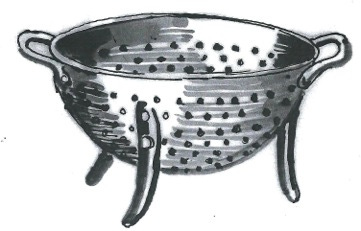
[I didn’t take a photo of Simon’s colander so here is a colander by the amazing ANNABEL LEE from my book CONSIDER THE FORK]
One of the objects I brought along to the Edinburgh event was my rotary whisk. I say ‘my rotary whisk’ but actually, like a fool, I gave away my own mother’s rotary whisk when my sister and I were clearing her house to sell it when she was suffering with dementia and had moved to a care home. I write about this at more length in THE HEART-SHAPED TIN.
Many of the possessions in our mother’s house caused me and my sister agonies before we let them go but getting rid of the rotary whisk felt like an easy decision for the simple reason that I have a long-held prejudice against them. I never thought that rotary whisks were very good at whisking. When I first left home, I became a balloon whisk person and never looked back. Balloon whisks were what I had seen chefs using on TV, lifting the egg whites high in the air with a confident circular motion. Any time I wanted to whisk something faster, I would reach for my hand-held electric whisk.
Now I see that, efficient or not, my mother’s rotary whisk was irreplaceable. I had looked at this utensil with cold eyes as if it were merely a tool, to be judged by what it could do for me. I didn’t see that whether it whisked eggs quickly or not, it was really a memento which held within its black plastic handle the vestiges of my own mother’s handprints. This was the tool with which she taught me and my sister to make cheese soufflé; and cakes; and macaroons.
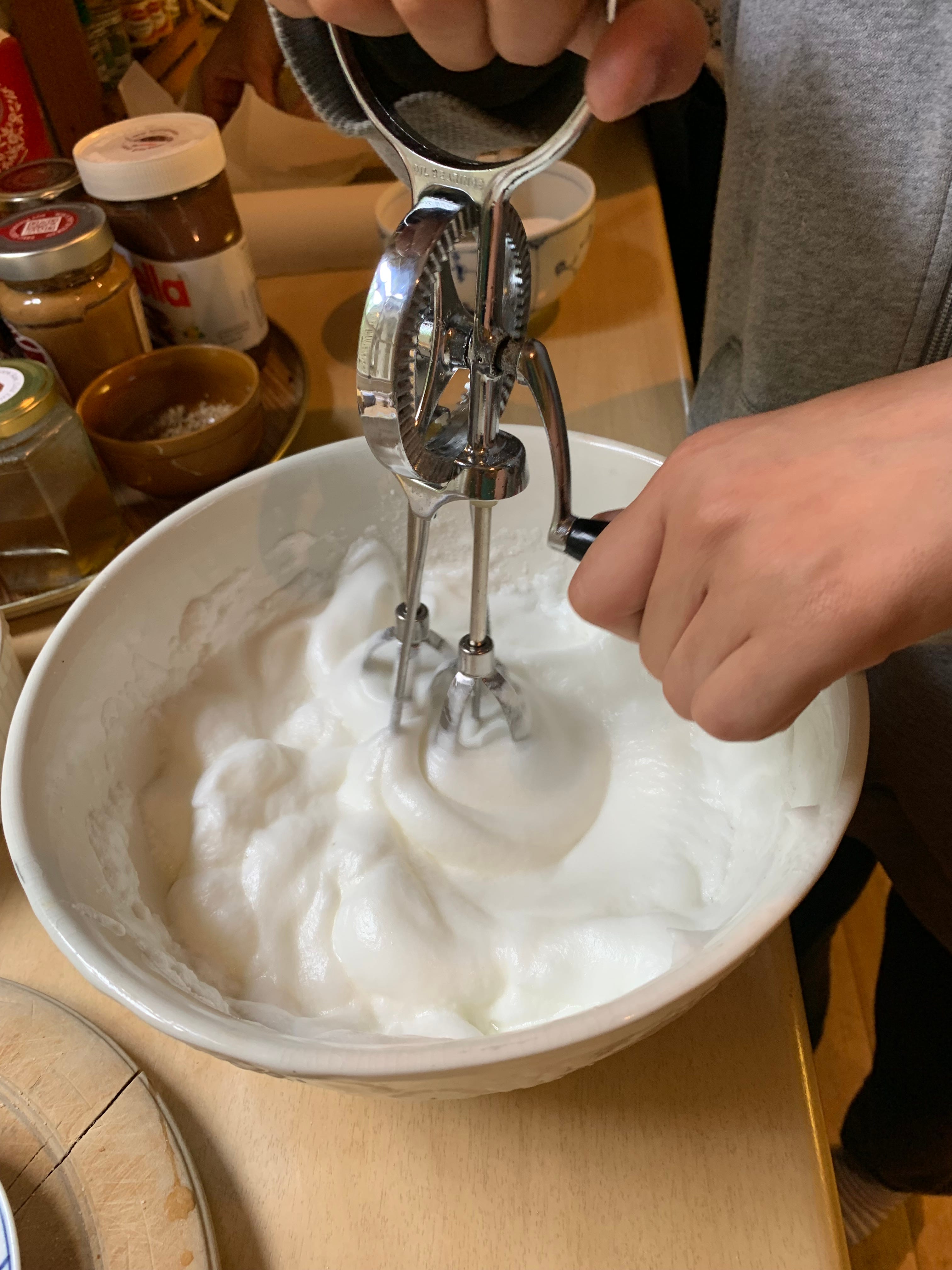
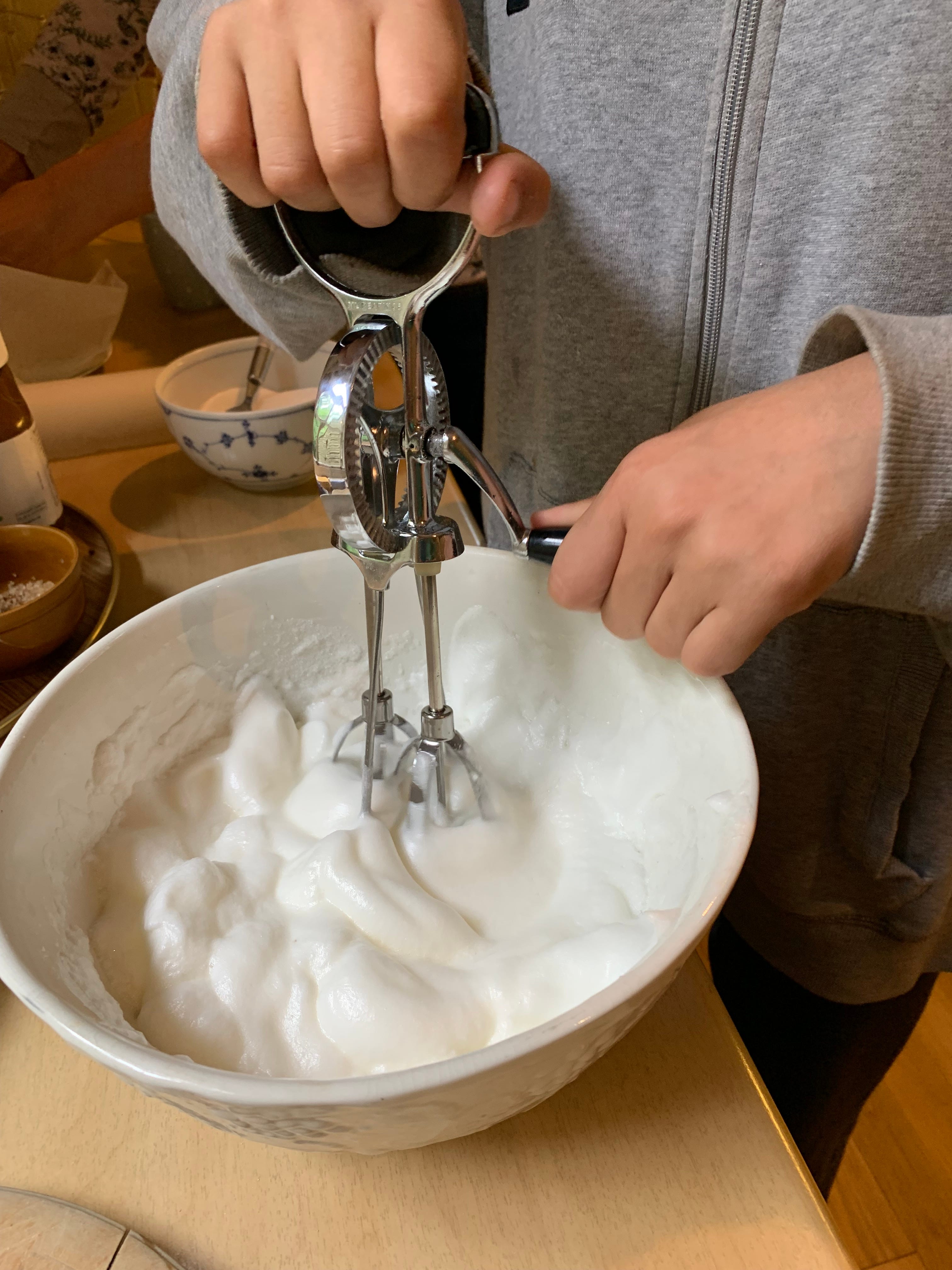
Recently, I found this photo of my youngest son whisking eggs using my mother-in-law’s rotary whisk four years ago and it could have been a photo of my own childhood - the ceramic mixing bowl! the hard-won cloud of egg snow!
My mother was a deeply stubborn and determined person, and there was something about the elbow grease required to get egg whites stiff with her rotary whisk that appealed to her even though it sometimes exhausted her so much that she had to take a break halfway through. A rotary whisk wasn’t flashy or modern and neither was she.
She died only a year after we emptied her house. Grief hits you in waves. After she had gone, I would have done anything to get her rotary whisk back. Instead, I found one on eBay - a Prestige egg beater. My youngest son likes to use it to beat eggs very very fast. But it isn’t the same.
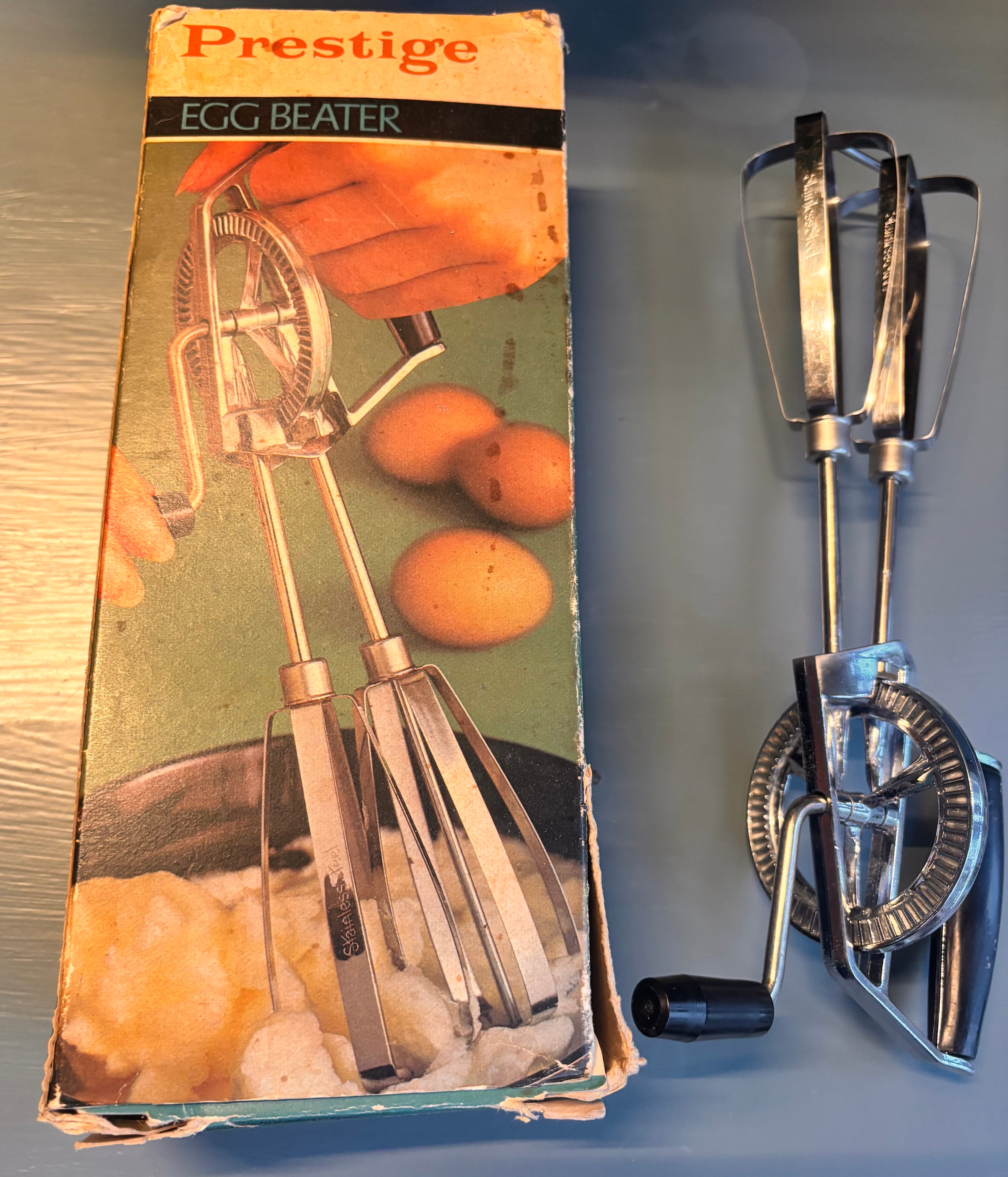
One of the audience members in Edinburgh who came up to me to get a copy of the book signed afterwards said that she ‘never expected to find’ herself ‘crying over a rotary whisk’. I’d brought along the Prestige whisk and asked the audience how many people remembered a parent or grandparent using one of them and a whole sea of hands went up. And it seems that I am far from the only one whose formative memories of cooking with a parent involve one of these tools.
Why does an old whisk make us so emotional? I think it’s because it’s a memento that we can actually still play with, as if we were children again. It brings back the gestures of those we have lost, more powerfully than any photograph. When I turn the handle of my rotary whisk - even though it’s the wrong one - I can see my mother’s hands again, alive and cooking.
P.S.
The trip to Edinburgh was one of those rare times when family life and working life aligns rather than clashes. My daughter, Tash, who graduated in Art this summer, had one of her paintings in an exhibition in Summerhall in the city and I was so moved and proud to see it actually up on the wall. It’s called Double Exposure and is based on a scene in Twin Peaks.

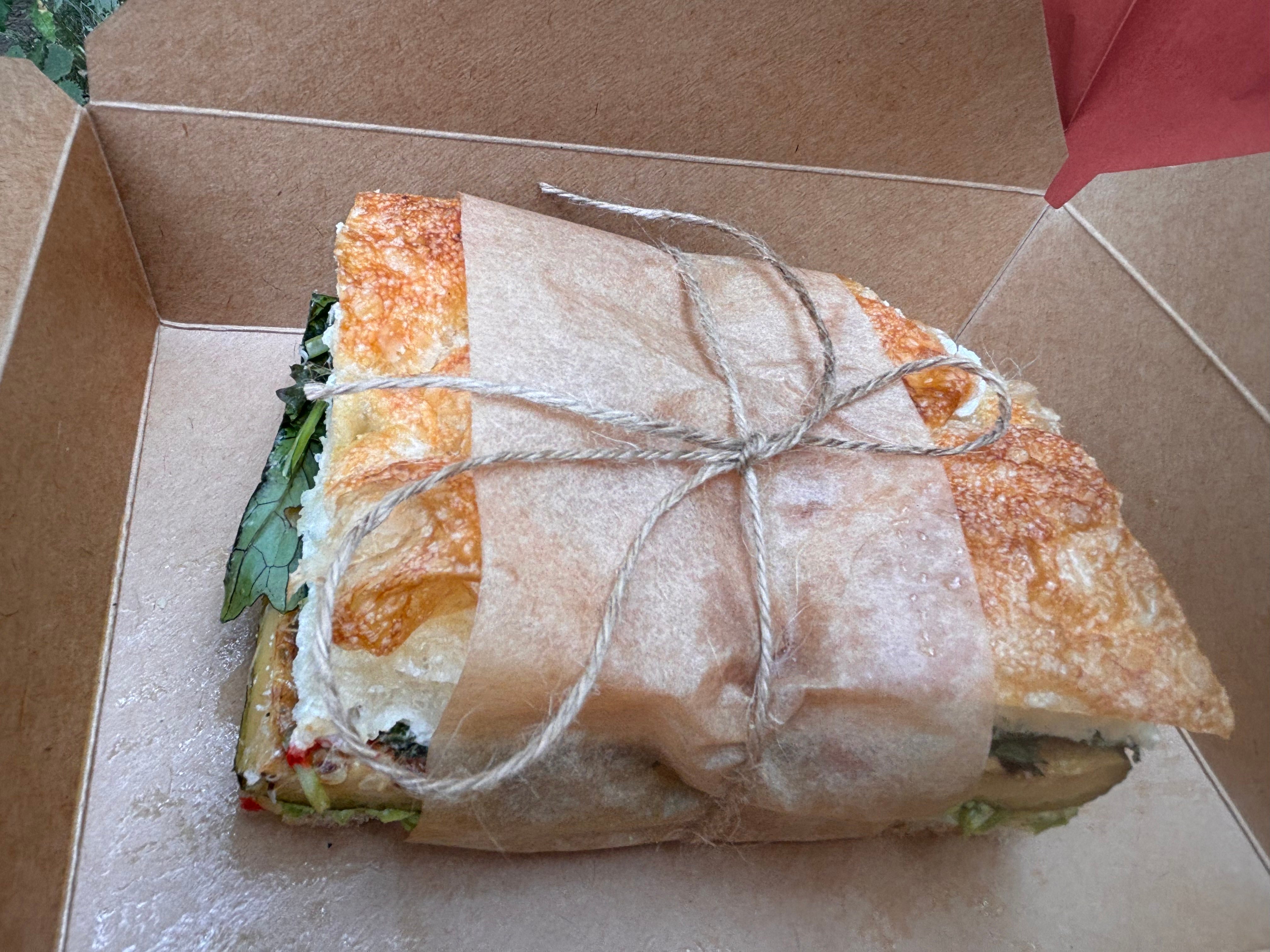
We wandered round the city together including through the Meadows, saw a fringe show, sat by the canal in Stockbridge watching an array of dogs and their owners walk by and went to Lannan bakery where we got some of the best sandwiches and sausage rolls and cardamom buns I’ve ever had. The sandwich was filled with courgette and goat’s curd and it was so juicy and perfectly seasoned and - most pleasing of all! - came tied with brown string.
P.P.S. On the subject of rotary whisks, one of my favourite stories that I wrote about in CONSIDER THE FORK was the great egg-beater boom of the late nineteenth-century in the U.S. The rotary whisk - which now seems so old-fashioned - was once excitingly new-fangled and seen as a whizzy labour-saving device. This was a moment in history when sweet things in American cuisine had become intensely aerated - there were creams and charlottes and apple snow and lemon snow and all manner of whipped frostings - and cooks were starting to rebel against their tired arms and looking for tools that could help them achieve airy egg whites with less effort.
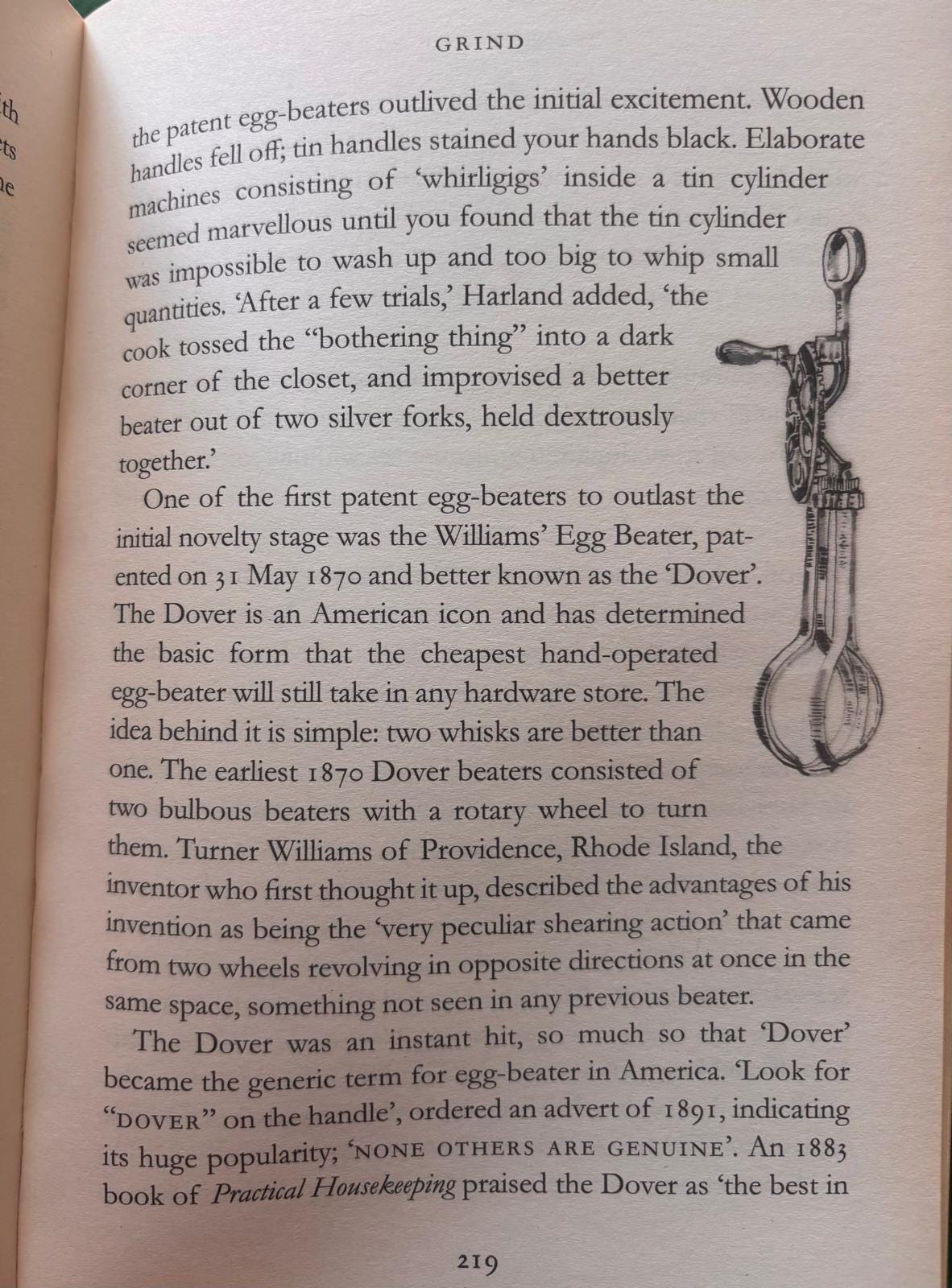
The ‘Dover’ was the iconic American version of the rotary whisk, first patented in 1870. The inventor - Turner Williams of Providence - boasted of the ‘very peculiar shearing action’ that came from two wheels revolving in opposite directions at once in the same space, something not seen in any previous beater. Marion Harland, a food writer at the time, wrote (in 1875) that she would not give up her Dover for a hundred dollars! (N.B. it would have cost around10-25 cents to buy at the time). She said that it enabled her to ‘turn out a meringue in five minutes’.
I find it astonishing to think that between 1856 and 1920, no fewer than 692 separate patents were granted for egg-beaters in the U.S. Some of the inventions sound wonderfully strange. I wish I could try one of the water-operated egg whisks, hooked up to running water.
Most of these new egg beaters seem to have offered few if any real advantages over a balloon whisk, although they made grand promises. The Dover claimed it could beat the whites of two eggs in ten seconds! If you’ve ever used a rotary whisk that can do this, I’d love to hear; your arms must be faster than mine.
This is not nearly as romantic as a grandmother’s colander or mum’s rotary whisky, but I’m (inexplicably) very attached to a bright red, silicone mini spatula. It doesn’t have history and I got it at the Dollar Store. But I love it. One summer, I left it at the cottage we rented; I couldn’t find a replacement anywhere and was - no exaggeration- bereft. I talked about it all year until we returned to the same cottage and went directly to the utensil drawer. When I found it there I was jubilant. Now it stays safely at home, never to travel again.
I can well imagine crying over such a thing. I recently acquired the first jigsaw that I remember completing as children. The turquoise recycled card backs were every bit as evocative as the illustrated laminated fronts. I made a gift of it to my twin brother last month. In the kitchen there was little that held the same nostalgia – Mum was no cook – but I can still see the roasting pan that my twin and I once dropped onto the floor after an unsuccessful check and baste of the chicken midway through it’s cooking (we returned the disgraced and displaced bird back to the pan before anyone could find out). And a toffee hammer and pickled onion jars that belonged to Dad, and lived in the pantry which will forever be memories that feel almost tangibly heavy.